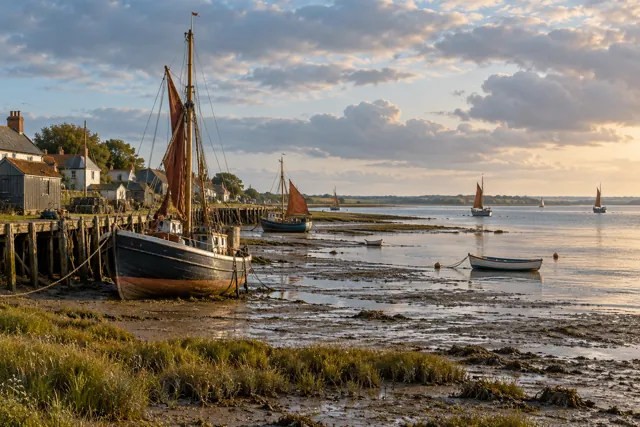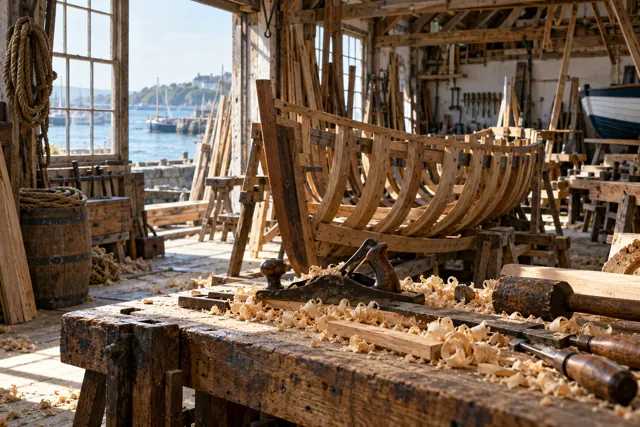
The visible passage was only one part of a cargo voyage. Before a sail filled, goods had to reach the quay, a suitable berth had to be available and the vessel had to be ready to receive a load. At the other end, the process had to work in reverse. A beautiful sailing performance could not compensate for cargo damaged by poor handling.
Traditional Thames barge logistics combined local collection, manual handling, careful stowage and decisions about tide and weather. The sequence below is an explanatory model of the trade, not a reconstruction of a recorded Edme voyage or a guide to operating a vessel today.
Start with the goods and their destination
A useful way to understand freight is to begin with the receiver. What quantity was needed, in what condition and at which landing place? A heavy commodity, a bulky light load and a moisture-sensitive product create different problems even if all three move between the same towns.
That distinction also explains why the word cargo is too broad to tell the whole story. Packaging affects how a load is counted and lifted. The condition of a hold affects what it can receive. A commercial agreement needs enough information to connect what leaves the supplier with what arrives at the destination.
Edme’s documented association with malt and acid provides a reminder that a single hull could serve different industries. It does not establish the packaging, quantities or handling method for every consignment. Those questions belong to more detailed business records than a vessel summary.
The quay was a transfer point
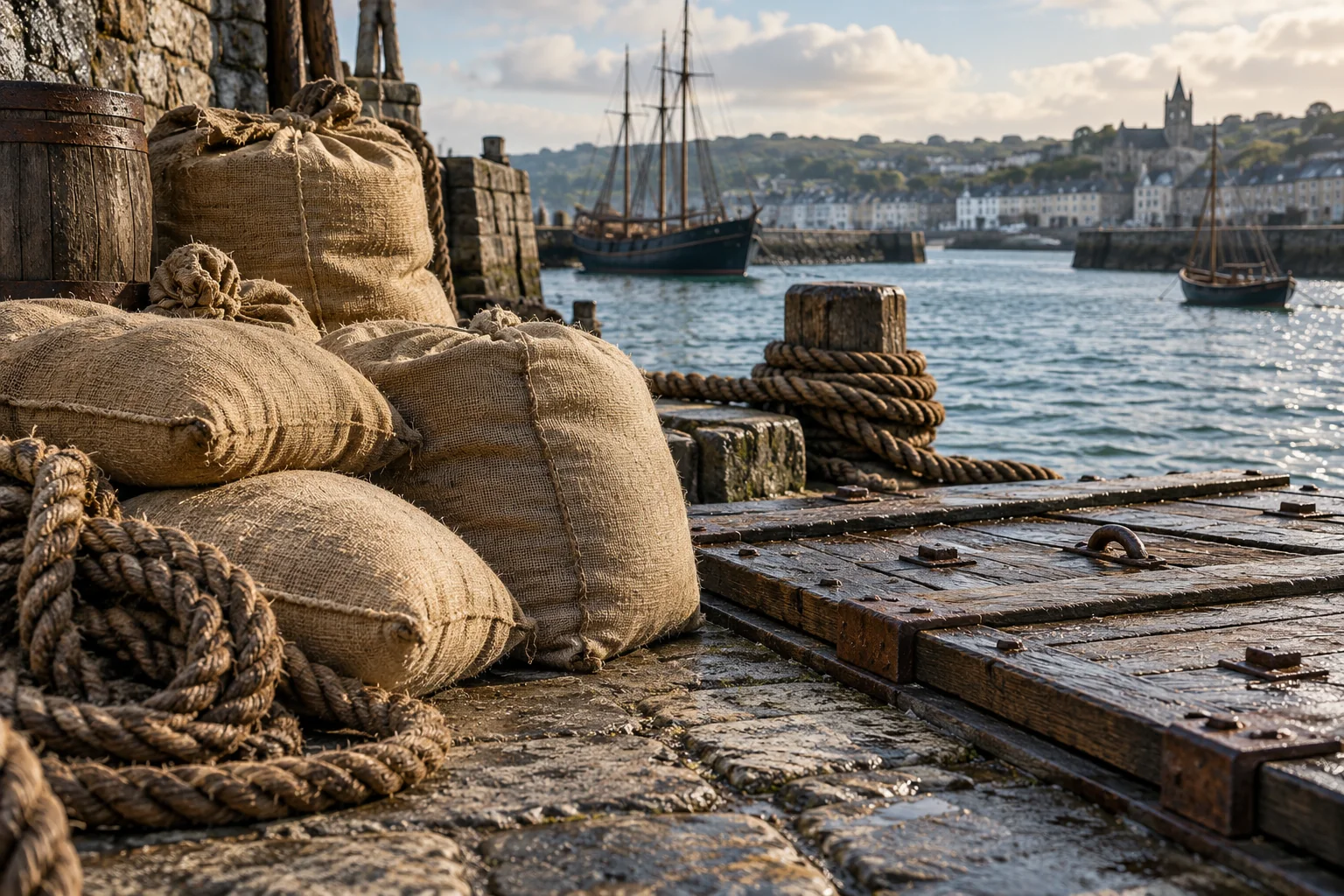
A quay joined two different environments. On one side were land transport, storage and production; on the other were a changing water level and a floating vessel. A successful transfer depended on the relationship between them. The height difference could change as the tide moved, even when the destination stayed exactly the same.
The obvious object to study is a lifting appliance, but the less obvious details matter too: where goods waited, how people moved around them and how the load reached the hatch. A wharf with little storage had a different rhythm from one connected to a substantial warehouse.
Imagine sacks arriving faster than a crew could stow them. Space on the quay would become a constraint before sailing speed did. Reverse the situation and an empty hold would wait for goods. This is a conceptual example, but it shows why transport history needs to include time spent stationary.
| Stage | Main question | Potential constraint |
|---|---|---|
| Collection | Can the goods reach the quay? | Landward access and waiting space |
| Loading | Can they enter the hold efficiently? | Lifting method and hatch access |
| Passage | When can the vessel move? | Wind, tide and loaded draught |
| Delivery | Can the receiver accept the load? | Berth, labour and onward transport |
Put the hold at the centre of the story
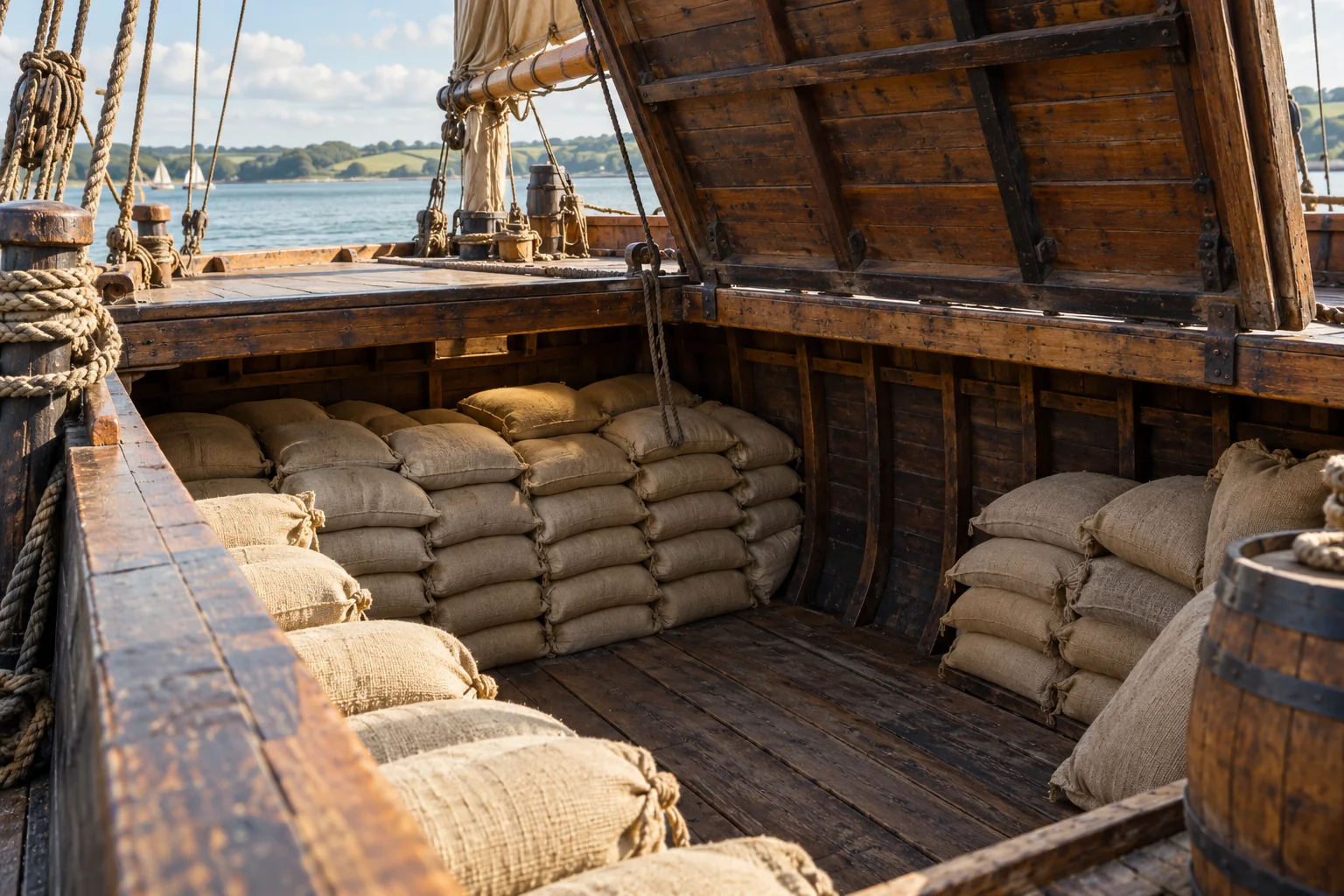
The cargo hold occupied the economic centre of a trading barge. Its value lay in usable space that could be reached, loaded, protected and emptied. A hold that looks generous in a modern interior photograph should still be interpreted through its former working function.
Stowage involved more than filling every gap. Weight distribution affects how a vessel sits in the water, while access and cargo protection affect handling. Some goods must be kept apart; others need an orderly sequence so the right consignment can be removed without disturbing everything else. The exact arrangement depends on the load.
Protective materials placed between cargo and the ship’s structure are often described as dunnage. Their purpose is easier to grasp than the term: create separation, protection or support as required. This explanation should not be mistaken for a claim about materials used on a specific Edme passage.
Close the opening, protect the load
A large hatch simplified loading but also created an opening through which weather could threaten cargo. The working system therefore included not only the hatch itself but the means of closing and securing it. The research society’s glossary distinguishes hatch-related fittings that can be difficult to identify in a general photograph.
The practical lesson is to study components together. A board, covering, fastening and raised edge may each seem minor in isolation, but their relationship explains how an opening could serve both access and protection. Shipboard engineering often becomes clearer when one follows the movement of water or force through the assembly.
Cargo care continued during the voyage. The crew’s responsibilities were not suspended once loading ended. A historical account focused only on navigation can miss why the goods were being carried and what condition the customer expected them to reach.
Tide created opportunities and limits
In shallow estuarine waters, the same berth could be accessible at one stage of the tide and unavailable at another. Draught also changes with the load. A vessel arriving light and leaving loaded may face different depth requirements at the same place. The timetable therefore emerged from relationships among water level, loading and destination.
This is why historical tidal work should not be reduced to simply drifting with the current. Wind, direction of passage, available depth and time required at the quay all mattered. Waiting could be a considered choice within an uncertain system rather than evidence of poor organisation.
A modern visitor can understand the principle by observing a creek at different water levels from a lawful public position. That observation is educational; it supplies neither a safe route nor a passage plan. Working navigation requires current charts, local knowledge and the appropriate professional judgement.
Delivery depended on shore arrangements
At the receiving end, the cargo had to become available for use. A waterside business might gain from a direct landing, while another receiver needed an additional cart journey or storage stage. Comparing voyages only by distance on the water ignores this last part of the cost.
Counting and condition checks also matter to historical interpretation. A discrepancy in an account could concern quantity, damage, timing or the terms of the agreement. Read the record’s purpose before treating a number as a complete description of the voyage.
The same discipline applies to photographs. Cargo visible on a quay may be waiting to load, recently discharged or unrelated to the nearest vessel. Position suggests a relationship; a dated caption or documentary link is needed to establish it.
Compare systems without romanticising them
Traditional cargo handling offers a useful contrast with unitised modern freight. Individually handled goods require repeated attention at transfer points. A standardised unit can move through different equipment and transport modes without each item being separately handled at every stage. The comparison concerns organisation as much as machinery.
Neither system can be evaluated without its setting. A small creekside collection and a long international supply chain solve different problems. The barge’s historical achievement was to fit a network of local places with considerable ingenuity. Its limitations were real, including exposure to weather and physically demanding work.
Reading cargo transport this way makes the surviving hull a practical document. The hold, hatch and quay form a connected story about people organising the movement of goods. For the larger technological transition, continue with the journal’s account of British maritime logistics; for the machinery itself, explore the guide to barge design and rigging.
Reader questions
Did barges always load from warehouses?
No single arrangement represents all trades. Loading places and equipment varied, so specific wharves require local records.
Why did shallow draught matter?
It could make smaller rivers and landing places usable. The available depth still depended on tide and the vessel’s loading.
Were all barge cargoes carried loose?
No. Commodity and packaging varied. Do not infer a particular packaging method from the vessel type alone.
Continue exploring: Brightlingsea and the Maritime Heritage of the Essex Coast, or return to Edme’s documented story.