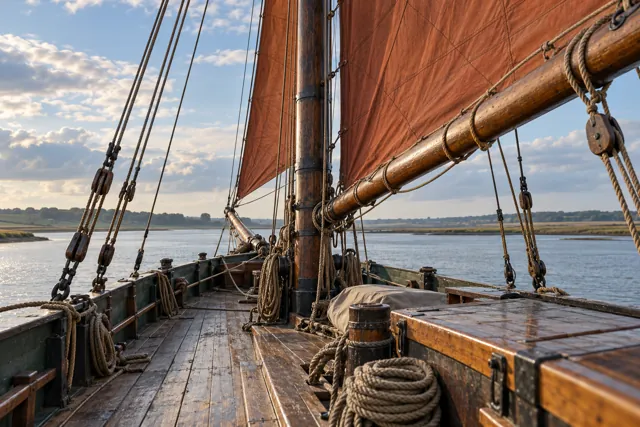
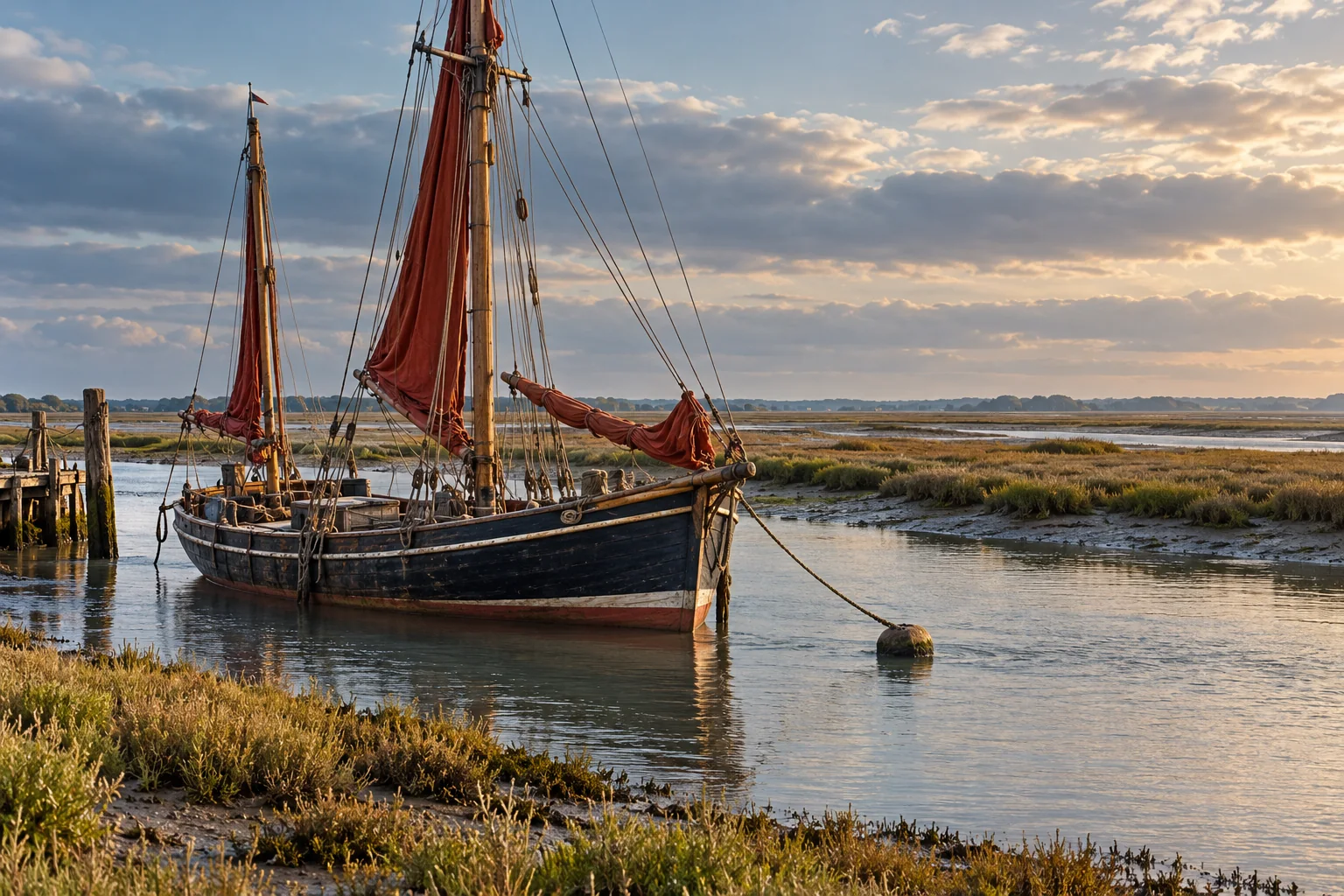
An estuary is easier to understand when the tide is out. The exposed edges show how little of a coastal working landscape consists of deep, open water. Channels, mud, slipways and moorings occupy a more complicated space. Brightlingsea’s maritime setting belongs to that meeting of land and water, where a harbour is also part of the life of a town.
Brightlingsea is a useful starting point for exploring the maritime heritage of the River Colne and the Essex coast. Read the waterfront alongside local museum evidence, and keep the town’s wider history separate from the movements or availability of any individual historic vessel.
Read the estuary before the vessel
The coast is often pictured as a line, with the sea on one side and land on the other. An estuary does not behave so neatly. Water enters channels and retreats from margins; places that appear close across a creek may be far apart by road. These relationships influenced the usefulness of different boats and landing places.
For a visitor, a map provides the first layer of context. Look for the river’s connection with the sea, the position of settlements and the branching pattern of smaller waters. Then ask which features would have mattered to somebody moving goods rather than somebody looking for a scenic viewpoint.
This way of reading geography helps explain why the broader Thames barge story belongs to Essex. A shallow vessel could serve a network whose smaller branches were commercially meaningful. It also explains why a modern road itinerary cannot simply reproduce a historical waterborne trading route.
A waterfront is a place of work
The most revealing features may be ordinary: a slope into the water, a quay edge or the relationship between a shed and a vessel alongside. Such details help connect a boat’s design with the labour needed to maintain and use it. An attractive harbour photograph seldom explains those relationships by itself.
Working waterfronts also change. A building’s present use may differ from its original one, and a restored vessel may have moved several times. Without dated evidence, appearance alone cannot establish either occupation or continuity. A visitor can enjoy the visual character while remaining precise about what is actually known.
Observe from public places and follow local signs. A boatyard or mooring is not automatically open for exploration because historic vessels are visible there. Asking permission protects working space and also provides a chance to learn which aspects of a site can be interpreted accurately.
| Place or evidence | What it can explain | What to check separately |
|---|---|---|
| Public waterfront | Scale, tidal setting and visible craft | Public access and local signs |
| Museum collection | Objects, names and historical context | Current opening and exhibitions |
| Vessel record | Construction and documented service | Present berth or sailing plans |
| Recent operator update | A dated operational announcement | Availability for your intended date |
Use the museum to widen the picture
Brightlingsea Museum offers a locally grounded route into the town’s past. Its own website is the appropriate place to check exhibitions and visitor information. Begin there rather than relying on a copied opening schedule, which may survive online long after the season changes.
A local museum can connect maritime objects with domestic and civic life. Tools, images and personal records encourage questions about who worked, where families lived and how a waterfront related to the rest of the town. A vessel-centred history becomes richer when those connections remain visible.
Treat an exhibit caption as a starting point for careful looking. Note the object’s date, purpose and source. A tool can illuminate a technique, while a family photograph may identify a person or place. Their value differs, and they do not need to tell the same kind of story to belong together.
Compare working craft by purpose
An oyster smack and a cargo barge may share waters without sharing a job. Hull shape, deck arrangements and equipment should be interpreted against their intended work. Comparing their silhouettes is enjoyable, but comparing what people needed to do aboard each vessel explains more.
Fishing requires an understanding of the particular fishery and its gear. Cargo transport centres on carrying capacity and transfer arrangements. Leisure sailing adds other priorities. The same local skills may contribute to several activities, but that does not make the vessels interchangeable.
When an old photograph shows mixed craft, resist assigning every boat to the nearest famous type. Identify what is visible first: number of masts, sail shape, deck opening or working equipment. Then compare with a properly captioned image or collection record. Uncertainty is a productive stage of research.
Place Edme within the regional story
Edme’s construction at Harwich connects her with another Essex maritime centre. Her registered association with St Osyth and the restoration history recorded by its boatyard add further places to the story. These connections explain why the barge cannot be understood through a single waterfront alone.
Brightlingsea also appears in descriptions and images associated with Edme. That association does not establish a permanent berth or a present departure point. A photograph records a moment; a current operator confirmation answers a different question. Mixing those two forms of evidence is how historical interest becomes unreliable travel advice.
For vessel-related updates, the Facebook page supplied for Sailing Barge Edme is a relevant external channel. Read the date of any post and obtain direct confirmation for arrangements. This independent journal does not take bookings or speak on behalf of the crew.
Plan a visit around an enquiry
A focused question makes even a short visit worthwhile. You might investigate how a quay meets changing water levels, how a sailing rig is supported or how a museum represents working families. Choose something that can be explored from public places and through published interpretation.
Combine outdoor observation with indoor evidence when possible. The waterfront supplies scale and geography; collections can supply names, dates and explanations that cannot be recovered by looking alone. Neither replaces the other. The comparison is especially valuable when a place has undergone substantial change.
Allow for weather, access and the pace of the people travelling with you. Check the destination’s own accessibility information rather than assuming a level route continues onto an old vessel. Being able to reach a waterfront does not imply that a gangway or below-deck space will be suitable for everyone.
Keep a small record of what you learn
A useful field note separates observation from interpretation. Write that a fitting was visible, then separately record what a label or source says it was for. Add the date and viewing position. This modest habit prevents an impression gathered on holiday from turning into an unsupported historical claim later.
If you take photographs, include the surrounding context where permitted. A close detail may become hard to identify without a wider view. Respect any restrictions and avoid recording people or private working areas unnecessarily. The best personal archive is one whose limitations are clear.
Brightlingsea rewards this patient approach because maritime heritage is more than a collection of impressive hulls. It is a way of seeing relationships: the town and the river, specialist work and ordinary life, a local story and a wider trading coast. Continue towards St Osyth or the history of coastal cargo carrying with those connections in mind.
Reader questions
Does a visit to Brightlingsea guarantee seeing Edme?
No. Historic vessels move and published associations are not live berth information. Confirm directly if seeing a particular vessel is essential.
Can I enter working yards to photograph boats?
Only where access is permitted. Use public viewpoints and ask the site operator before entering private working areas.
Where should I check museum opening times?
Use Brightlingsea Museum’s own visitor information and contact it if your plans depend on a specific date or access requirement.
Continue exploring: Inside a Traditional Thames Sailing Barge: Design, Rigging and Life Aboard, or return to Edme’s documented story.