Start with the empty space. On a traditional cargo barge, the hold explains much of what surrounds it: the hull must carry it, the hatch must provide access and the rig must move the resulting load. The familiar red sail is only the most conspicuous part of an integrated working vessel.
A Thames sailing barge combines a shallow cargo-carrying hull with a sailing rig adapted to its trading environment. Spritsails, leeboards and the organisation of deck space help explain that relationship. This is a guide to the vessel type; it does not claim to document Edme’s present interior or provide sailing instruction.
The hull makes room for the trade
Think of the hull as both container and structure. Its shape influences capacity and access to shallow water, while its framing supports the loads imposed by cargo, rig and sea. A broad outline is understandable only when those responsibilities are considered together.
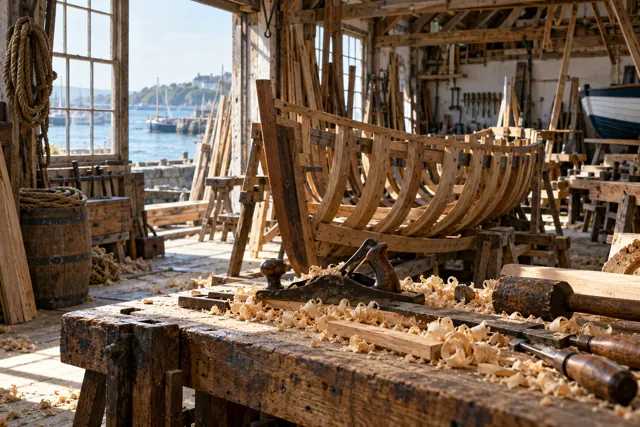
The flat-bottomed form associated with Thames barges helps explain their relationship with tidal creeks. Yet flat does not mean structurally simple. Timber components must connect and transmit loads, and the shape still needs to work as a vessel moving through water. Looking at a cross-section or a museum model can clarify what an exterior photograph hides.
Material also matters. Wooden and steel barges require different maintenance techniques, even when their overall working logic is similar. Edme is recorded as wooden; the broader history of the type should not be written as if every surviving example shares that construction.
Leeboards supply resistance where it is needed
The large boards beside the hull are among the easiest features to notice and the easiest to misunderstand. A leeboard lowered on the downwind side provides underwater area that resists sideways drift. Its usefulness is especially clear when a shallow hull is compared with a deep-keeled sailing yacht.
Because the board can be raised, that underwater area does not have to impose the same permanent depth. The arrangement links sailing performance with shallow-water access. It is a practical compromise rather than a decorative survival from an earlier age.
Do not confuse resistance to leeway with a full explanation of stability. The whole vessel’s form, loading and other characteristics matter. A short introductory description cannot replace the analysis of a specific hull. When reading a simplified museum explanation, retain that distinction rather than extending one sentence into a general engineering claim.
| Term | Plain explanation | Working purpose |
|---|---|---|
| Sprit | Diagonal supporting spar | Supports the spritsail |
| Leeboard | Movable board beside the hull | Resists sideways drift when lowered |
| Brails | Lines for gathering sail | Help bring canvas under control |
| Hatch | Access opening into the hold | Connects cargo space and deck |
| Keelson | Longitudinal internal structural member | Contributes to the hull’s backbone |

The sprit supports a working sail
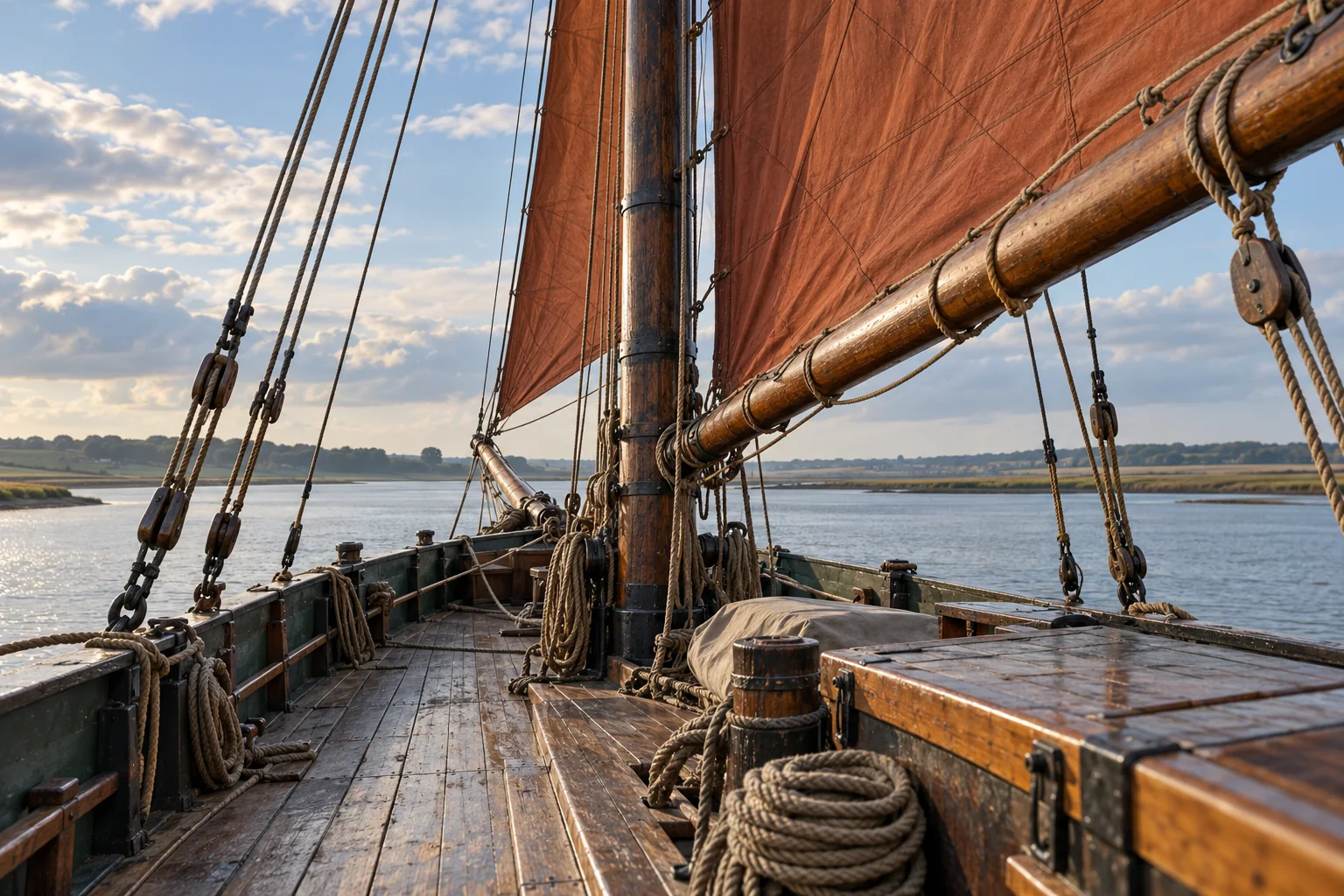
A sprit is a spar set diagonally to support the mainsail. Recognising it helps distinguish the characteristic rig from other traditional sail plans. The sail’s shape and support system make more sense when viewed together than when its colour is treated as the identifying feature.
The rig also includes ropes, blocks and supporting gear. Standing rigging supports the spars, while running rigging is used in handling sails and related operations. The distinction is useful vocabulary because it separates support from adjustment without requiring every rope to be memorised at once.
Look for where a load ends up. A sail pulls on its fittings; the mast and its supports transmit forces into the vessel. A pulley changes the arrangement of a line, but the structure carrying the pulley still has to bear the resulting force. Following those connections makes a complicated photograph readable.
The deck is an organised workplace
Hatches, winches and the paths taken by lines compete for space on deck. A fitting’s position can therefore reveal the sequence of work. A clear area might be necessary for handling rather than evidence that the designer forgot to use it.
The hatch is especially revealing. It connects the cargo space with the outside world but must also be closed and protected. Raised edges, removable coverings and securing arrangements should be interpreted as a system. The Society for Sailing Barge Research’s glossary helps distinguish parts whose names are unfamiliar.
A visitor should leave working ropes and equipment alone unless explicitly invited and supervised. An apparently idle line may still be connected to a load. Learning from a vessel involves understanding the workplace, including the limits placed on where visitors can stand and what they can touch.
A hold is not originally a saloon
Many historic commercial vessels have acquired new uses. An open interior suitable for hospitality or accommodation may occupy space once intended for freight. A later arrangement can be part of the vessel’s history, but it should not be projected backwards into its trading career.
The Thames Barge profile of Edme describes a converted hold with domestic furnishings. That is a published description, not a current access promise or a measured plan. The practical enquiry about present facilities belongs with the owners or operator.
For historical interpretation, compare uses across time. What had to be removed, added or retained to make a cargo space serve people? How were changes recorded? Such questions respect the later life of a vessel while keeping its original purpose visible.
Life aboard followed the work
Crew accommodation on a working vessel had to coexist with the space and tasks required by the trade. Cooking, resting and maintaining equipment were not separate from the economic purpose of the hull. They were conditions that made continued work possible.
Avoid imagining one universal domestic routine. Crew arrangements changed with vessel, route and period. Published recollections can reveal details, but the author’s date and experience should remain attached to the account. A memorable story from one barge is not automatically a description of every other crew.
This is also where objects can widen the story. A cooking utensil or personal possession can connect the vessel with everyday life, while a crew record identifies responsibilities and relationships. Neither needs a dramatic anecdote to be historically useful.
Learn the vocabulary through relationships
An effective first glossary is small and functional. Link each term to the problem it helps solve: a hatch provides access, a leeboard resists drift and a brail is associated with gathering sail. That approach is easier to retain than an alphabetic list read without a vessel in view.
For deeper study, compare a labelled plan with photographs taken from different angles. A line that seems to end in one image may continue behind another component. Differences between examples can reflect a genuine variation, a later alteration or simply an obstructed view.
The reward is the ability to see a barge as a connected design. Shape, space, rig and crew work belong to the same explanation. Once those relationships become familiar, the next red sail on an estuary carries a more precise meaning: an adaptable piece of commercial machinery, preserved through continuing attention to how it works.
Reader questions
Why does a barge have boards on its sides?
They are leeboards. Lowering the leeward board helps resist sideways movement while allowing the vessel to retain a shallow hull.
Is the large diagonal spar a boom?
On a spritsail rig, the prominent diagonal supporting spar is the sprit. Other sail plans use different arrangements.
Did trading barges have today’s visitor interiors?
Not necessarily. Many present interiors reflect conversion or restoration. Use dated plans and records to establish an earlier arrangement.
Continue exploring: St Osyth Boatyard and the Preservation of Historic Wooden Vessels, or return to Edme’s documented story.