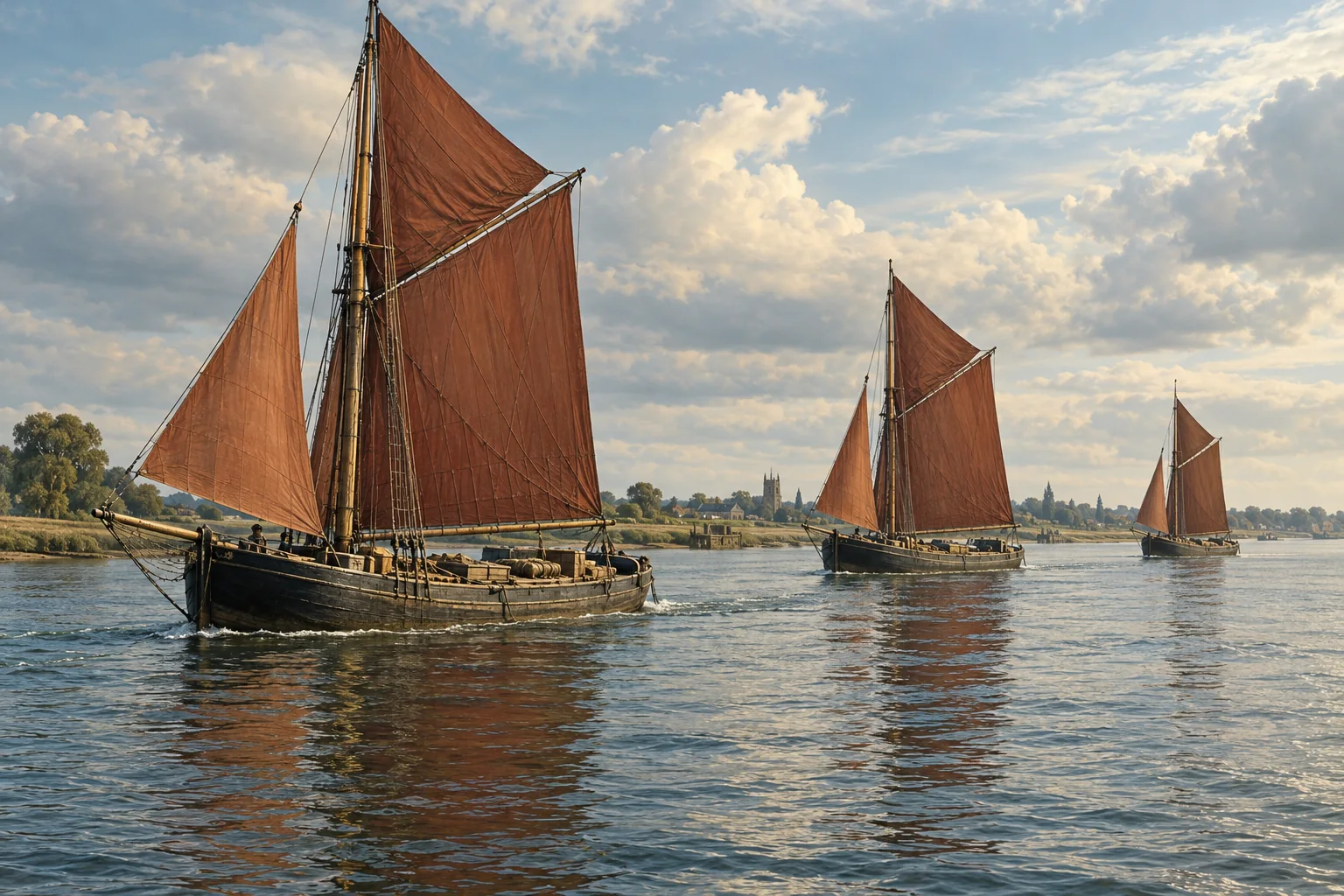
A red sail on a grey river can look timeless. The vessel beneath it was a response to quite specific pressures: shallow water, awkward cargoes, expensive labour and customers scattered along creeks rather than gathered at a single deep-water terminal. Understanding that commercial setting makes the Thames sailing barge more interesting than a picturesque survivor.
Thames sailing barges were cargo vessels adapted to the rivers and coastal waters of south-east England. Their importance lay in linking small loading places with larger markets using a shallow hull and an economical sailing rig. This article traces the type’s development; individual vessels followed different careers.
Begin with a transport problem
Before judging a historical vessel by its speed, ask what journey it needed to complete. A waterside farm, maltings or brickworks required more than movement along the main river. Its goods also had to reach the water, cross a quay and arrive at a usable berth. A vessel able to collect close to production could avoid intermediate handling.
That makes a creek part of the transport system rather than an obstacle outside it. Tidal access might constrain departure, but access itself had economic value. A larger vessel with a deeper hull could be impressive offshore and useless at the actual loading place. The barge’s proportions made sense within this wider journey.
An evolving vessel, not a single invention
The term Thames sailing barge describes a developing family of craft, not one unchanging plan. Sail arrangements, steering systems, materials and size varied. Looking for a single moment when the complete modern type appeared tends to hide the smaller adjustments made by builders and working crews.
An informative museum model is therefore evidence of one configuration. Compare its date, the location it represents and whether it depicts a trading vessel or a later restoration. An object can accurately illustrate its own subject without representing every barge on every river. Royal Museums Greenwich’s collections provide useful starting points for these comparisons.
The Sailing Barge Association places particular emphasis on nineteenth-century development. Its account connects the barge matches with improvements in sailing performance. This is a useful corrective to the idea that commercial tradition necessarily meant technological stagnation: owners could value familiar working methods while still seeking a better passage.
| Lens | Question to ask | Evidence to seek |
|---|---|---|
| Design | What constraint did the feature solve? | Plans, photographs and physical fabric |
| Trade | What goods moved on this route? | Freight accounts and quay records |
| People | Who performed each task? | Crew agreements and oral history |
| Survival | What changed after trading? | Repair records and dated ownership histories |

Why the familiar shape worked
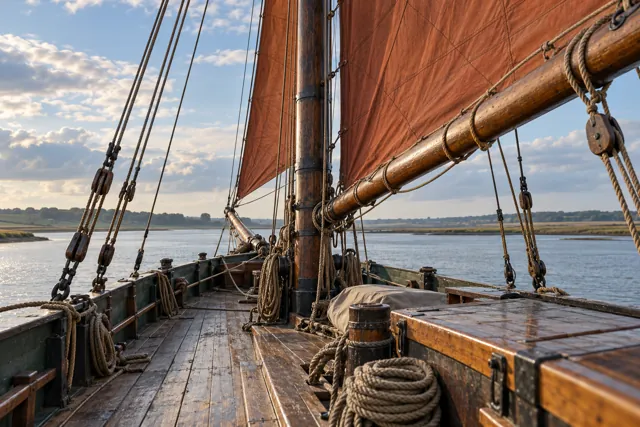
A broad, relatively shallow hull offered room for cargo without demanding the underwater depth of a deep-keeled yacht. Leeboards helped resist sideways movement under sail and could be raised when their depth became inconvenient. The hull and its movable underwater surfaces answered different parts of the same practical problem.
Above deck, the spritsail rig is the most recognisable feature. A long diagonal spar supports the mainsail, while ropes and blocks distribute the work of handling canvas. It is better to read these details as working machinery than as decoration. Each line needs a route, each load a support and each operation enough space.
None of this made the vessel effortless. A design that reduces the number of hands still depends on trained hands. Economy may increase the responsibility carried by each person rather than eliminate labour. Sail handling, steering, cargo care and decisions about weather remained connected tasks.
Cargoes tied the river to ordinary life
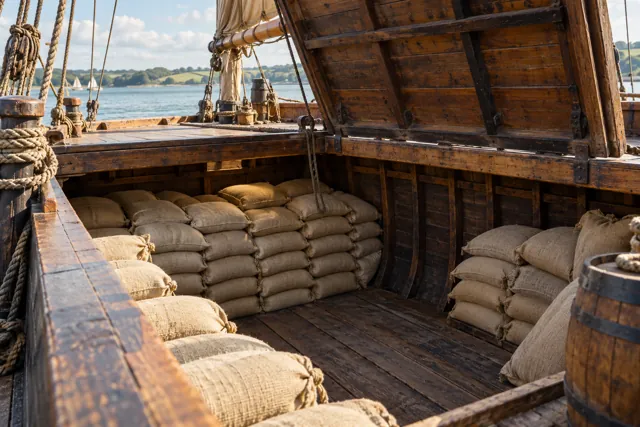
Barge history is also the history of goods that rarely become museum centrepieces. Agricultural produce, building materials and industrial supplies reveal what towns consumed and what surrounding districts produced. Instead of treating a cargo list as trivia, ask what each commodity needed from transport: space, protection from moisture, careful stowage or a nearby landing place.
Edme offers a specific example within this larger story. The National Historic Ships record associates her with malt and acid cargoes. These are documented details of her service, not a licence to assign every typical barge cargo to her. Separating the fleet’s varied work from one vessel’s record keeps the history useful.
A return cargo mattered in principle because an empty passage still occupied vessel and crew. Yet the possibility of a return load does not prove that a particular voyage carried one. Freight books and commercial correspondence are needed to move from economic explanation to a reliable voyage history.
Small crews and large responsibilities
Accounts of barging frequently emphasise small crews. The research society’s overview describes several patterns rather than one universal complement. Crew size could depend on vessel, passage and period. The familiar shorthand about two people should invite questions about work organisation, not obscure the contribution of other crew members or shore labour.
Loading and unloading also joined shipboard work to a larger workforce. A vessel could be economical at sea while depending on people, equipment and storage ashore. Consider the whole sequence: assembling goods, checking quantities, making the hold ready, handling the cargo and making it available to the receiver.
Personal records can restore the individuals behind that sequence. Names, wages, family connections and recollections complicate an image dominated by sails. Oral history is especially valuable when read alongside dated documents; memory can explain a practice while an account book establishes when a transaction occurred.
Competition changed the network
Sail did not disappear simply because someone invented an engine. Different forms of transport overlapped, each offering advantages on particular routes. Railways and roads could change the cost of the landward journey, while powered craft changed the relationship between movement and weather. Customers assessed the complete service, including handling and delivery certainty.
The survival of a method in one niche is therefore compatible with its decline elsewhere. A vessel might continue working after its original commercial model weakened, sometimes in a different role. Lightering, storage and domestic reuse belong to the history too, even when they produced fewer dramatic images than sailing.
Preservation changed what survival meant
The Thames Sailing Barge Trust records its origins in a club formed in 1948, when enthusiasts recognised the loss of commercial sail. That response helped establish a different reason for keeping barges: education, participation and the preservation of skills. A working object was becoming a historical responsibility.
For today’s reader, the most rewarding question is not merely how old a barge is. Ask what evidence survives in its structure, how alterations have been recorded and which skills allow it to remain intelligible. A replaced plank and a documented repair can tell a richer story than an unsupported claim that everything is original.
Edme belongs within that continuing conversation. Read her individual record alongside the fleet’s history, and the red sail becomes an entry point into the relationships between production, geography, labour and conservation. The vessel is memorable because those relationships can still be explained through something tangible.
Reader questions
Were Thames barges only used on the Thames?
No. Their history also belongs to estuaries, coastal passages and connected trading places. The operating range of a particular barge needs its own evidence.
Did every barge have red sails?
Red-brown dressed sails are characteristic, but sail appearance and treatment vary. Colour alone cannot identify a vessel.
Is a restored barge still historical evidence?
Yes. Original material, alterations and documented replacements can all carry information when their dates and purposes are understood.
Continue exploring: How Thames Sailing Barges Transported Cargo Before Modern Shipping, or return to Edme’s documented story.