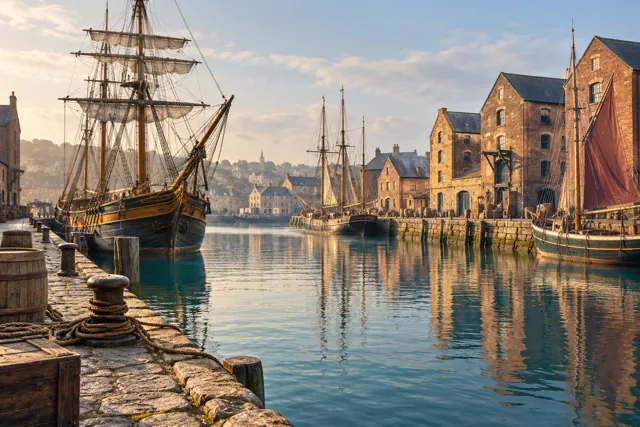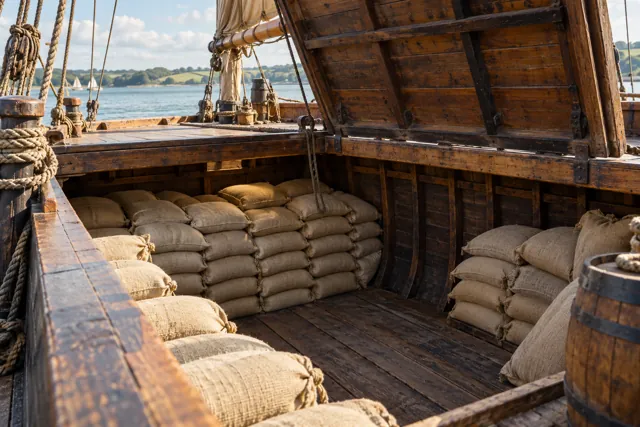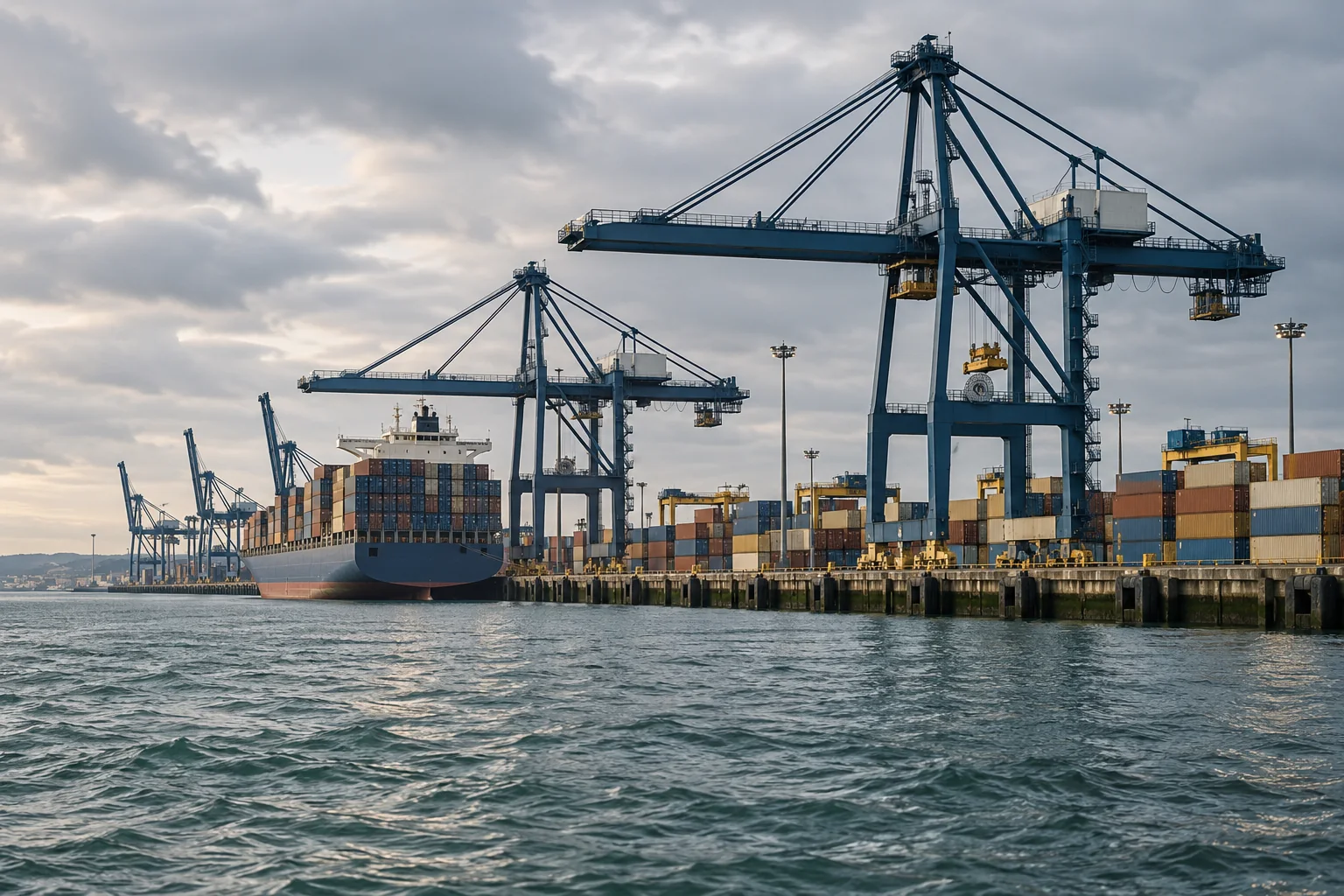
A change in transport technology often becomes visible as a different vessel. The more consequential change may happen ashore: a new terminal, a railway connection or a way to move goods without unpacking them at every transfer. Maritime logistics is the organisation of a journey, not simply the machinery that crosses the water.
British maritime transport evolved through overlapping systems of sail, powered shipping and increasingly integrated freight handling. Thames barges show the value of fitting a vessel to local collection points; modern ports show how standardisation and large networks can reorganise that relationship. The comparison below explains mechanisms rather than claiming a single cause for change.
Measure the complete journey
Suppose a consignment moves quickly on the water but spends a long time waiting at each end. Its sailing time alone will be a poor measure of the service. The receiver cares about when usable goods become available, while the supplier must consider the cost of bringing them to the loading place.
This simple distinction changes the questions asked of history. Instead of ‘which ship was fastest?’, ask where delays occurred and who carried their cost. Loading, storage, documentation and onward transport can make the same vessel more or less useful on different routes.
Thames barges are instructive because access to small waterside places could reduce intermediate movements. Their scale should be understood in that setting. The best vehicle for a dispersed collection network is not automatically the best vehicle for moving a large standardised consignment over a long distance.
Sail and machinery overlapped
New propulsion offered ways to reduce dependence on favourable winds, but it also brought costs and requirements of its own. Fuel, engines, maintenance and supply arrangements belong to the calculation. Commercial adoption is not explained merely by identifying which technology came later.
Likewise, the absence of an engine did not eliminate expense. A sailing vessel still required a hull, gear, labour and maintenance. It could make economic sense under particular conditions without being costless to operate. Edme’s engineless record is historically notable, but should not become a claim that sail solved every commercial problem.
Vessels and routes could change incrementally. Some craft acquired auxiliary power, while others continued under sail or found different uses. These overlapping careers are a better subject for research than a dramatic boundary after which one complete era supposedly ended.
| Question | Traditional barge context | Modern integrated freight context |
|---|---|---|
| Where to collect? | Small quays and creekside places | Terminals and connected distribution sites |
| What to handle? | Individual packages or commodity loads | Standard units where suitable; specialised bulk systems |
| What constrains timing? | Wind, tide, handling and berth access | Schedules, terminal capacity and network connections |
| What must be coordinated? | Crew, shore labour and receiver | Carriers, terminals, inland transport and information |
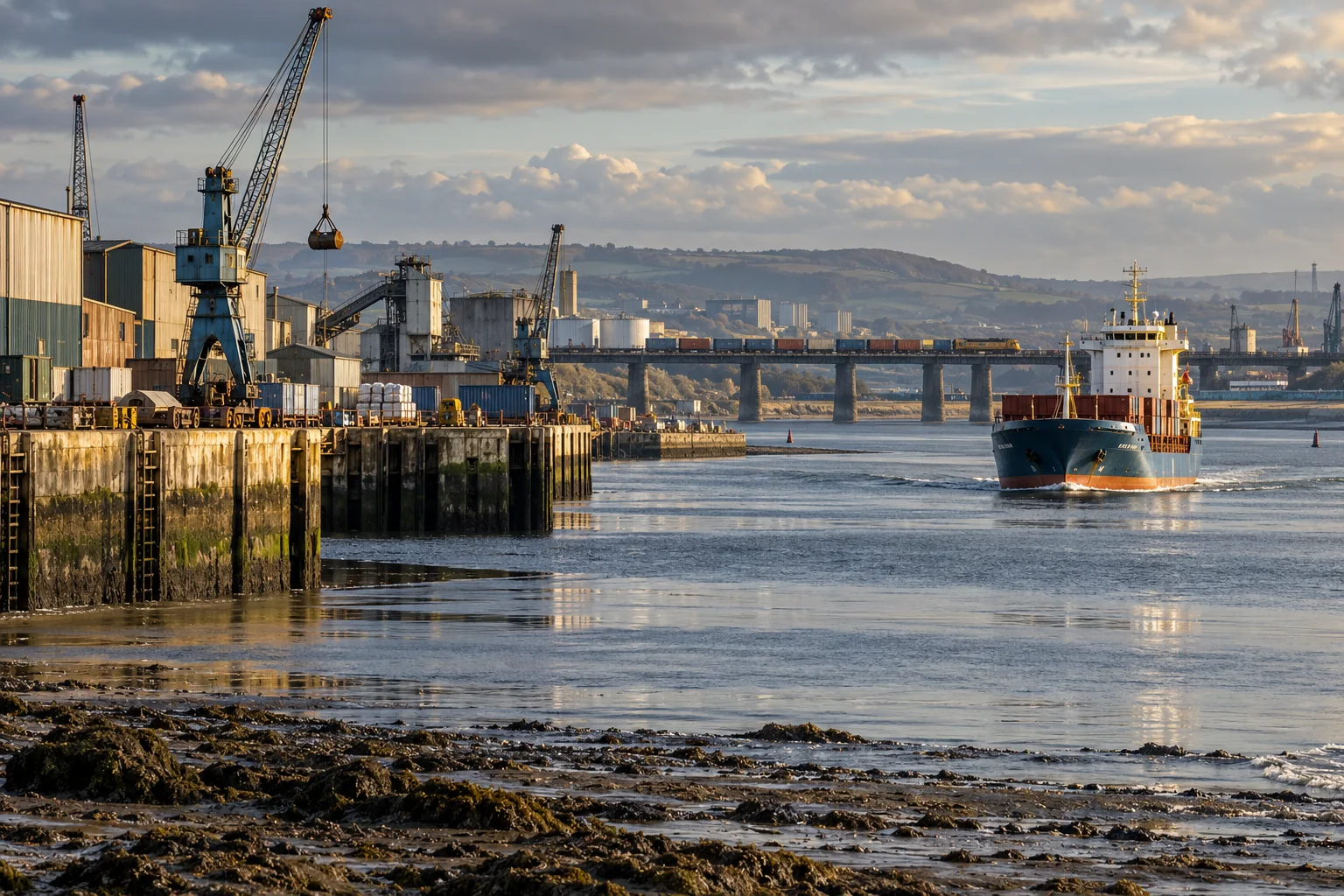
Land transport changed maritime choices
A port is only as useful as its connections. Railways and roads can alter which loading place serves a producer or customer most effectively. A new landward option may weaken one waterborne route while increasing traffic through another terminal.
Think of the network as several linked decisions. Goods move from origin to collection point, between terminals and then to their final receiver. Improving one link can change the preferred arrangement of the others. This is an explanatory model, not a quantified reconstruction of a particular historical trade.
It also discourages a misleading competition between ‘land’ and ‘water’ as entirely separate systems. Cargoes frequently need both. The historically interesting question is how they were joined, what had to be handled at the join and whether that transfer added cost or uncertainty.
Ports were institutions as well as places
The Port of London Authority’s history describes the establishment of the authority in response to the organisation of the river and docks. London Museum explains the subsequent shift towards container facilities farther downriver, including the opening at Tilbury in 1967. These changes involved governance and geography as well as ships.
A harbour authority, a dock owner and a cargo operator need not be the same body. Distinguishing their functions helps interpret a source correctly. A statement about managing navigation is not necessarily a statement about who handles a shipment or owns a warehouse.
Historical maps make the spatial consequences visible. Compare where cargo was received, where storage stood and how goods travelled onwards. When these relationships change, the commercial meaning of an old quay may change even if the quay itself remains physically present.
Standardisation moved the transfer point
Containerisation made a transport unit central to the organisation of freight. Rather than handling every item separately at every interface, compatible equipment could move a larger unit through successive stages. The effects extended to terminals, road vehicles, rail connections and information.
This principle is easier to understand through a small thought experiment. Count each time a set of goods must be lifted, sorted or repacked on a hypothetical journey. Then imagine those goods remaining together inside a suitable unit. Some tasks move to different places; others disappear or become mechanised.
The example does not mean all freight can use the same system. Bulk liquids, loose aggregates and awkward project cargoes raise different questions. Nor should a container’s presence be treated as proof that a whole journey is efficient. Connections and waiting time still matter.
Reliability is a commercial quality
A customer may value a predictable arrival even when another option occasionally completes a faster passage. A reliable delivery allows work, labour and storage to be organised with less uncertainty. This is one reason speed alone cannot explain changes in freight systems.
Different risks also sit with different participants. A supplier, carrier, terminal and receiver may experience the same delay in different ways. Their records are likely to emphasise different parts of the problem, so reading across sources can reveal what a single account leaves out.
Avoid imposing a modern performance target on a historical operation without context. A local trade accustomed to tidal schedules could organise around them. The relevant comparison is with the alternatives and expectations of that period, not with a present-day parcel notification.
The waterfront became less visible to some people
Large terminals can separate everyday urban life from the physical handling of goods. A historic quay integrated with a town offers a different experience from a fenced industrial port. The difference affects how the public imagines maritime work, even though consumption still depends on transport networks.
Museums and historic vessels can help reconnect the visible object with that wider system. A cargo hatch opens questions about handling; a warehouse prompts questions about storage and delivery. The value of the old technology lies partly in making these operations legible.
This is not a reason to dismiss modern infrastructure or to idealise hard manual work. Both deserve accurate interpretation. A balanced account recognises technical ingenuity and also asks whose labour, working conditions and communities were affected by each arrangement.
Read continuity alongside change
Wind, water depth, transfer points and maintenance remain meaningful considerations, although their relative importance differs across systems. The surviving barge and the container terminal answer a shared question: how can goods be moved through a particular network at an acceptable cost and level of reliability?
That question provides a more useful bridge between maritime heritage and logistics than a simple sequence of inventions. Begin with a cargo’s complete journey, then examine the vessels, places and institutions that make it possible. Edme’s story becomes one precise part of a much larger history of organising movement.
Reader questions
Did powered shipping immediately replace barges?
No. Transport methods overlapped, and their usefulness depended on route, cost, cargo and connections.
Did containers replace all other cargo handling?
No. Many commodities need bulk or specialised systems. Containerisation is one important system within a varied maritime industry.
Why compare a barge with a modern port?
The comparison reveals how access, handling and coordination shape transport. It does not imply that the vessels serve identical markets.
Continue exploring: Exploring Britain’s Maritime Heritage: Historic Vessels, Ports and Waterfronts, or return to Edme’s documented story.